
A child’s love for learning grows when learning feels meaningful, manageable and deeply connected to who the child is. Long before children learn to write full sentences or solve more complex equations, they are already forming powerful beliefs about learning itself: Is it exciting? Is it safe to try? Am I capable? Do my ideas matter?
These early beliefs influence whether children become passive followers or active thinkers, whether they avoid difficulty or lean into it, and whether they see learning as a chore or a lifelong source of joy.
At Cambridge Pre-school, this understanding shapes how we design our programmes. We see learning as a meaningful relationship each child builds with the world around them. Our role is to nurture that relationship with care, so children learn with curiosity, confidence, and a genuine desire to discover, question, and grow.
Confidence Begins in the Everyday
One of the earliest foundations of a child’s love for learning is confidence. Before children can embrace new ideas, they need to feel capable in their everyday world. That is why our Self-Help Skills curriculum matters so much. In the early years, independence shapes how children see themselves.
This comes through clearly in our Practical Life Skills Programme. When children learn to care for their belongings, follow routines, and take responsibility for simple tasks, they gain more than useful habits. They build self-trust. They begin to understand that effort leads somewhere and that they are able to do meaningful things for themselves.
That sense of capability changes how children approach learning. A child who feels confident managing small tasks is often more willing to try something unfamiliar, less intimidated by challenges, and more ready to keep going when something does not come easily at first. Practical life experiences give children an early belief in their own competence, and that belief helps curiosity grow.
Real Progress Keeps Interest Alive
Alongside confidence, children also need to feel that learning is rewarding. Interest stays alive when children can sense themselves growing, when something that once felt difficult begins to make sense. Our Academic Skills curriculum gives children the support and momentum to enjoy learning and feel successful in it.
Within this curriculum, for example, our Phonics and Reading Programme and Literature Alive Programme work together in a meaningful way. Phonics helps children build confidence with the mechanics of reading, while Literature Alive helps them experience the joy and meaning behind it. That combination matters because children begin to love it when skill opens the door to something richer.
A child learning phonics is slowly unlocking words, but the deeper shift happens when those words begin to form stories that matter. In Literature Alive, stories become vivid, expressive and emotionally engaging. Children listen because they want to know what happens next. They start wondering about characters, imagining possibilities and connecting what they hear to their own lives. That is when reading becomes something enjoyable, memorable and worth returning to.
Character Gives Learning Staying Power
Confidence and academic progress are important, but they are not enough on their own. Children also need the inner qualities that help them stay open to learning when it becomes challenging, shared, or emotionally demanding. This is why our People Skills is such an essential part of our approach.
At the heart of this is our Character Development Programme. We see character as part of learning itself. A child may be naturally curious or capable, but if frustration quickly overwhelms them, or if they struggle to listen, adapt, or recover from setbacks, learning can begin to feel discouraging.
Character gives learning staying power. Through this programme, children build resilience, responsibility, empathy, and self-control. These qualities shape daily learning in powerful ways. A child who can recover from a mistake is more likely to try again. A child who can listen and work with others is more open to shared discovery. A child who is learning to regulate emotions is better able to stay with a challenge instead of withdrawing from it. In this way, character development supports the emotional strength that helps learning remain positive and worthwhile.
Discovery Turns Learning into Something Personal
A lasting love for learning also depends on discovery. Children are naturally curious, but curiosity grows stronger when it is given meaningful direction. Through our Future Skills curriculum, children are encouraged to explore ideas in active, imaginative ways and iSTEAM is a key part of that experience.
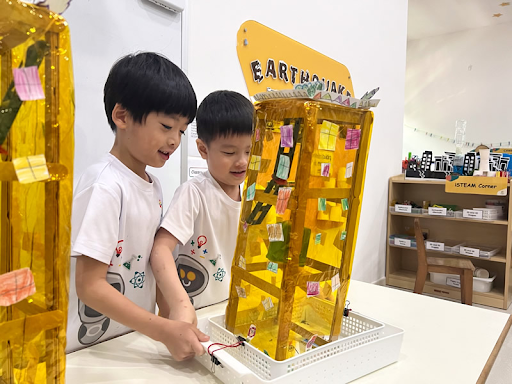
What makes iSTEAM so engaging is that it turns learning into something active. Children investigate, build, test, observe, and rethink. They actively use information through hands-on exploration, testing and problem-solving. That matters because children are often most engaged when learning feels hands-on, purposeful and real.
In iSTEAM, the most powerful moments often come through exploration and problem-solving. A structure that failure becomes a reason to think again. A surprising result is a reason to look more closely. In these moments, children begin to see that their ideas can be tested, adjusted and improved. Learning becomes personal because they are taking part in understanding how things work, and that sense of ownership is one of the deepest roots of a genuine love for learning.
Where a Love for Learning Takes Root
At Cambridge Pre-school, this is what we aim to nurture in every child: the confidence to begin, the motivation to keep growing, the character to stay engaged, and the curiosity to keep discovering. When these come together, learning becomes more than something children do in school. It becomes something they enjoy, value, and carry with them.
Contact us today to explore our programmes and see how we can help your child build a strong, joyful foundation for the years ahead.