Bilingual education is often associated with communication, but in pre-school years, its influence reaches into the way children think, learn and respond to the world around them. At this stage, the brain is developing at remarkable speed. Neural pathways connected to memory, attention, reasoning, and flexibility are being shaped through everyday experiences, especially those that invite children to notice patterns, make meaning, and respond with intention. In a bilingual environment, that mental work becomes part of daily life.
This matters because cognitive development grows through repeated, meaningful experiences that encourage children to remember, connect ideas, shift perspective, and express themselves clearly. A bilingual pre-school setting creates those opportunities in ways that feel natural and lasting. Here are 5 ways bilingual pre-school supports cognitive development.
1. It Strengthens Memory Through Active Recall
One of the clearest cognitive benefits of bilingual learning is stronger memory. In a bilingual environment, children are constantly retrieving and applying what they know. They learn that an object, action, or idea may be expressed in two different ways, and they begin selecting the right word according to context.
That process keeps the brain active. A child is linking meaning across two language systems, recalling previous exposure, and using that knowledge in real time. Over time, this strengthens working memory, which supports many parts of early learning. It helps children follow instructions, remember story details, hold ideas in mind during play, and connect new information to what they already know.
The experience becomes even more powerful when language is tied to something meaningful. Stories, songs, conversations, and imaginative role-play give children a reason to remember. At Cambridge Pre-school, our Literature Alive programme is built on that understanding. We make language learning meaningful, expressive, and engaging. We bring children into stories, rhythm, and expression so that language feels vivid, memorable, and connected to real experience. When children encounter language in this way, they are more likely to attach meaning to it, remember it, and use it with confidence. That makes the learning deeper, because language becomes something they can feel, interpret, and carry into their own thinking and expression.
2. It Develops Flexibility Through Mental Shifting
Bilingual learning also supports cognitive flexibility, the ability to shift attention, adapt to change, and approach situations from different angles. This is especially valuable in the pre-school years, when children are learning how to manage transitions, routines, and new expectations.
In a bilingual setting, children quickly discover that meaning can be expressed in more than one way. The same thought may sound different depending on the language, and they learn to adjust as needed. That repeated practice helps the brain become more comfortable with change. Instead of depending on one fixed route to understanding, children begin to move more easily between possibilities.
This can shape how they respond in everyday situations. A child may cope better when routines shift, stay calmer when instructions are phrased differently, or keep trying when one approach does not work. These small moments reflect an important kind of mental adaptability, one that supports learning beyond the classroom.
3. It Sharpens Attention Through Intentional Listening
Attention in early childhood involves noticing what matters, staying engaged, and processing information with care. Bilingual learning strengthens this because children need to listen more closely.
To make sense of two languages, they begin paying attention to tone, rhythm, sound, pronunciation, and context. They learn to pick up on subtle cues that help them understand meaning. In other words, they are learning how to listen with purpose.
Parents often notice this in simple but meaningful ways. A child may become more attentive during story time, more responsive in conversation, or more capable of following multi-step instructions. These shifts matter because attention underpins nearly every aspect of early learning. It affects how children participate, how well they process information, and how confidently they engage with others.
4. It Deepens Reasoning Through Pattern Recognition
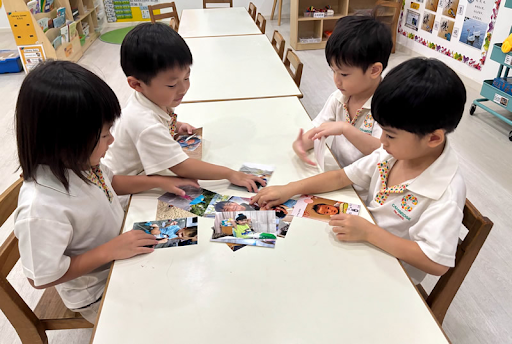
Language has structure, and young children notice that structure earlier than many adults realize. They hear repeated sounds, recognize familiar sentence patterns, and begin to understand how meaning changes with context. In a bilingual environment, they are exposed to two systems of structure rather than one, giving them more opportunities to compare, sort, and make sense of relationships.
That naturally supports reasoning. When children notice similarities and differences across languages, they are doing more than learning vocabulary. They are analyzing, categorizing, and recognizing patterns. These are early forms of logical thinking that also support literacy, numeracy, and problem-solving.
In fact, at Cambridge Pre-school, we extend that pattern-seeking mindset beyond language. Through our iSTEAM Inquiry Curriculum, we encourage children to investigate, test ideas, and connect learning across different areas. When children learn to recognize patterns in language, we help them carry that same habit of mind into numbers, design, inquiry, and discovery. Through iSTEAM, children learn to follow ideas through cause and effect, ask sharper questions, and see how one insight can lead to another. This gives their thinking more structure and purpose, helping them approach learning with greater confidence, independence, and depth.
5. It Builds Confidence Through Meaningful Expression
Confidence in communication has a direct effect on learning. Children who feel able to express themselves are more likely to ask questions, join discussions, and stay engaged when something feels unfamiliar or challenging. In a bilingual pre-school environment, that confidence grows gradually through repeated experiences of understanding and being understood.
A child begins to realize, “I know what this means”, or “I can say this”. Those moments may seem small, but they shape how children see themselves as learners. A child who feels capable is more willing to speak up, attempt an answer, or try again after making a mistake.
This matters because cognitive development depends on active participation. Children refine their thinking by expressing ideas, testing what they mean, and adjusting their understanding as they engage with others. With over 30 years of experience, we know that children use language more boldly when that confidence is grounded in real ability. That is why a strong foundation in listening, speaking, reading, and writing across both languages matters.
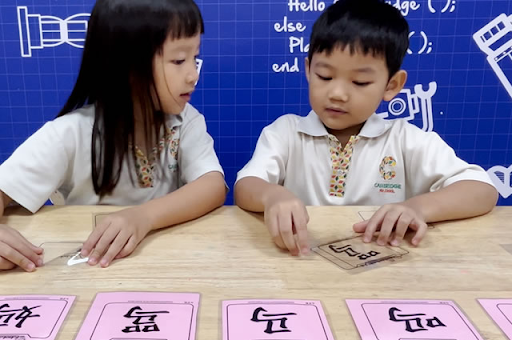
Our Chinese Reading Programme supports this by helping children grow more secure in their language use over time. As understanding deepens, children become more willing to speak, respond, and take part with greater assurance. That growing sense of ease matters in a bilingual setting, because children are more likely to use language actively when it feels familiar and dependable. In time, that confidence supports fuller participation in class and a stronger readiness to express ideas with clarity.
A Stronger Foundation for Learning
Bilingual pre-school strengthens memory, flexibility, attention, reasoning, and confidence in communication. These are learning capacities children draw on every day as they listen, respond, solve problems, and make sense of new experiences.
For parents, bilingual education is a way to shape how their children learn from the very beginning. When children are immersed in rich, responsive language experiences, they build habits of mind that support clear thinking, active participation, and lasting confidence.
At Cambridge Pre-school, we nurture that growth with purpose. We give children the language-rich foundation to think deeply, express themselves, and step into learning with confidence. Book a school tour with us today, and discover how we can support your child’s bilingual education.