Chapter 1
My Story
I was a late developer. I was a mediocre child in primary school. It wasn’t until secondary school that I realised I could improve if I put in some effort. I only started excelling in college and did well enough to be accepted by Harvard to pursue my Ph.D.
I observed something interesting along the way. Most of my classmates who did well in primary school sizzled out in secondary school. Similarly, many who were top children in secondary school did not do as well in college. Based on this observation, I see an academic career as a long-distance race and not a sprint. Those who peak too early may not have the stamina to win, or even complete, the race in the end.
It’s important for our children to achieve balance in their education, ensuring they are well-prepared and confident in their abilities without feeling the pressure to always be the best in class. My own journey, from being a top child in college to facing the intense competition at Harvard, taught me valuable lessons about the challenges of maintaining one’s confidence among equally talented peers. This experience highlighted the importance of resilience and the potential consequences of extreme pressure, such as burnout or more severe reactions, which some may face when transitioning from being a standout child to one among many high achievers.
This has shaped my educational philosophy for my children: helping them to be competent and self-assured learners, without the stress of needing to be at the top of their class. I believe in fostering an environment where they can excel at their own pace, preparing them not just academically, but also to be distinctive and valued members of society. Thus, my ideal educational setting for my children would prioritise their holistic development, ensuring they are:
- Independent (not overly dependent on adults and maids to do everything for them)
-
Competent and confident in their academic abilities (without the necessity of being the top child)
-
Poised to make a unique contribution and be acknowledged in their community and beyond (to be recognised by their peers)
-
Prepared for the future full of unknowns (and survive, come what may)
I will continue illustrating the second point in Chapter 2 on Self-help Skills, the third point in Chapter 4 on People Skills, and the fourth point in Chapter 5 on Future Skills.
Dream Outcome
I have summarised here my selection criteria for my pre-school dream outcome:
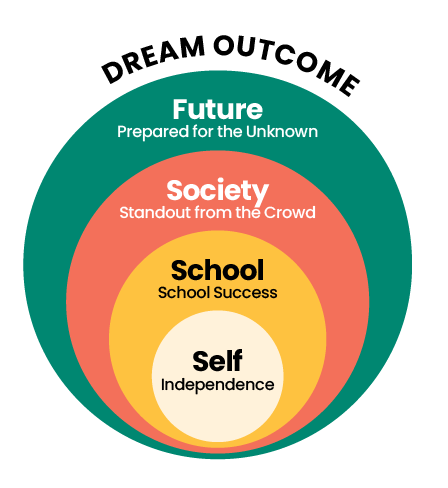
Cambridge pre-schools are designed and developed based on this dream outcome. My children graduated from a Cambridge pre-school; I walk the talk.
Skills Required for the Dream Outcome
To achieve this dream outcome, we need:
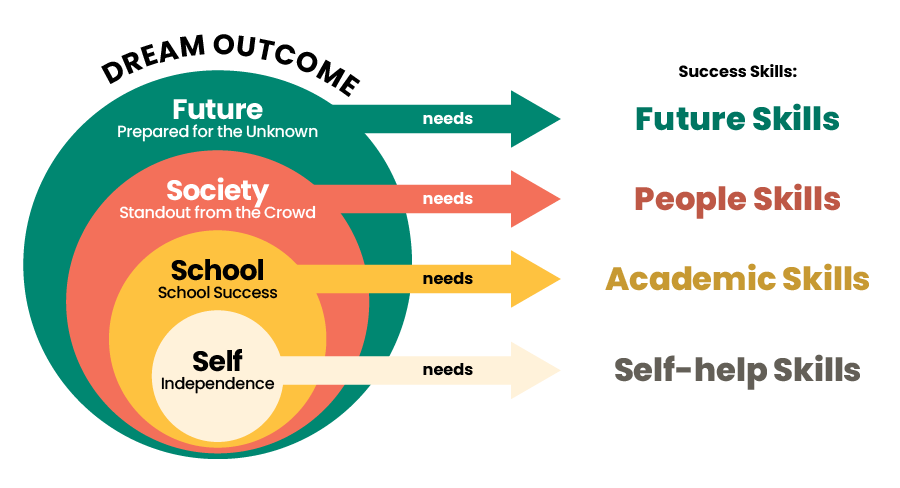
We will now discuss each skill in sequence in the following chapters.
Reflections
- Considering the changing nature of our world, do you believe that a traditional pre-school adequately equips your child for the future?
- Does Cambridge’s holistic, comprehensive approach to early education align with your personal vision for your child’s educational journey?