
Chapter 4
My Story Continues
Growing up and throughout my academic journey, including my time at Harvard, I was deeply focused on academics, often overlooking the value of practical life skills.
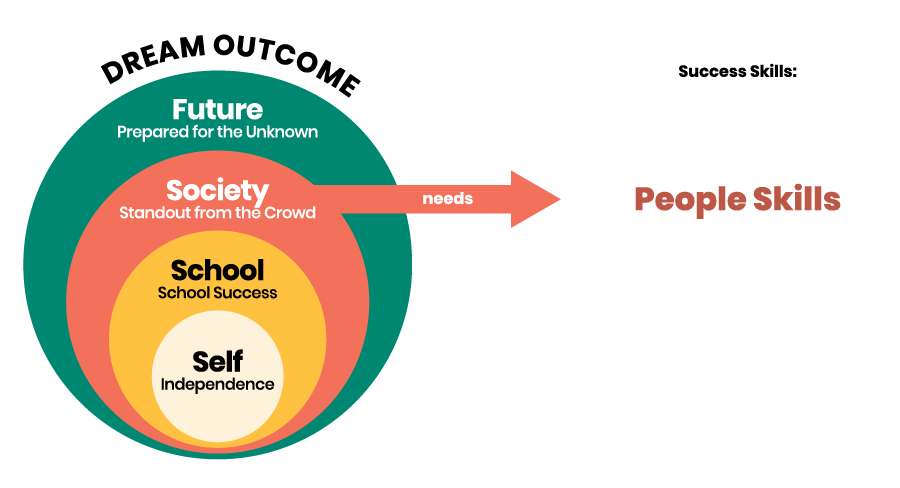
It wasn’t until I entered the workforce, started my own business, and began managing teams that I truly understood the importance of people skills. These skills, which include empathy, effective communication, and the ability to foster positive relationships, became crucial in my interactions and business dealings, especially in cultures where personal connections, like “guanxi” in China, are vital. My experiences taught me to value and improve my listening skills, taking into account others’ insights and perspectives.
Furthermore, in the future, when much of our cognitive skills can be delegated to AI, our people skills become even more important. For this reason, our Cambridge curriculum emphasises the cultivation of people skills as we will see in this chapter.
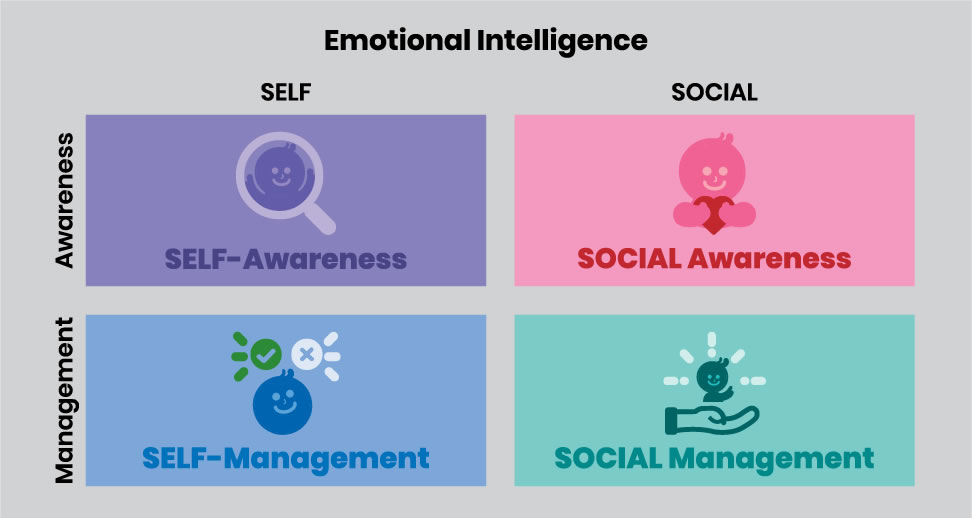
EQ consists of awareness of self and others as well as regulation of self and others.
Emotional intelligence (EQ) is the ability to understand and manage our emotions and those of others. It involves self-awareness, self-regulation, social awareness, and relationship management. EQ is crucial because it helps us navigate social complexities, lead effectively, and maintain healthy relationships. In the realm of business and personal interactions, emotional responses often have a greater impact than logical arguments. Recognising the importance of EQ, our curriculum at Cambridge is designed to enhance these skills through engaging stories, social activities, teacher modeling, and involvement in charitable efforts.
Develop Executive Function (EF)
Executive function (EF) refers to a set of cognitive processes that regulate our thoughts and actions, enabling goal-directed behaviour. These include skills like self-control, working memory (holding information in mind for short periods), mental flexibility (adapting to new information), focused attention, and planning. EF is critical for academic success and daily life management.
Self-Control
One key component of EF is self-control, which is the ability to regulate our impulses and delay gratification for long-term gains. The famous Marshmallow Test by Stanford University psychologist Walter Mischel demonstrated this: children who could resist eating a marshmallow immediately in favour of getting two marshmallows 15 minutes later showed better life outcomes in adulthood, including higher academic scores, healthier lifestyles, and greater wealth. This illustrates the profound impact of self-control on future success.
This is not difficult to understand.
Children with better self-control, such as studying first and playing after, achieve better academic outcomes, secure higher-paying jobs, save and invest more, and become wealthier.
Children with better self-control, eat more nutritious food, consume less junk food, drink less, exercise more, and become healthier.
Because children with better self-control become healthier and wealthier, they are also more satisfied with life.
At Cambridge, we prioritise activities that enhance EF, including games and exercises that challenge children to practise self-control, focus, and flexible thinking. These activities are designed to be enjoyable and engaging, fostering essential life skills in a supportive environment.
EF Assessment
Appropriate development of Executive Functions (EF), including self-control, focused attention, and working memory, is crucial for children’s readiness to learn. Challenges in EF are linked to various conditions like ADHD and autism, but the good news is that EF skills can
be enhanced through targeted practice and supportive environments.
I possess good EF and self-control, therefore I successfully delayed gratification to pursue my Ph.D., which took 6 years. Hence, I never suspected that my son would have ADHD. He was only diagnosed in primary 5 when one of his teachers raised this possibility.
Therefore, at Cambridge, we are doing EF assessment for early screening and early intervention.
One of the assessment tests asks children to sort items by shapes or colours. For example, a child may be given an orange lion card and asked to match only the shape. He must learn to ignore the colour and focus on the shape, which requires self-control.

It is harder than you think when you watch this video.
Due to its importance, EF training and assessments are regularly conducted at Cambridge. The assessment screens children to ensure they have the basic EF skills in place and are ready to learn. If not, it allows more time for early intervention.
Character Development
We believe in cultivating not just academic readiness but also essential life skills, good habits and moral values that form the foundation for success and happiness in life. Our character development curriculum is infused with core values such as empathy, respect, kindness, courage, resilience, honesty and an appreciation for differences as they embrace their own uniqueness and individuality. Through a blend of interactive activities and meaningful experiences such as stories, songs, games and role-playing, the children learn to understand, internalise and practise these values in their daily lives.
The development of good habits is fostered from toddler age to set a strong foundation, as learning and reinforcing of habits consistently become ingrained over time. Through positive social skill development, the children learn how to cooperate, share, take turns, and eventually learn to resolve conflicts peacefully.
Talent Discovery
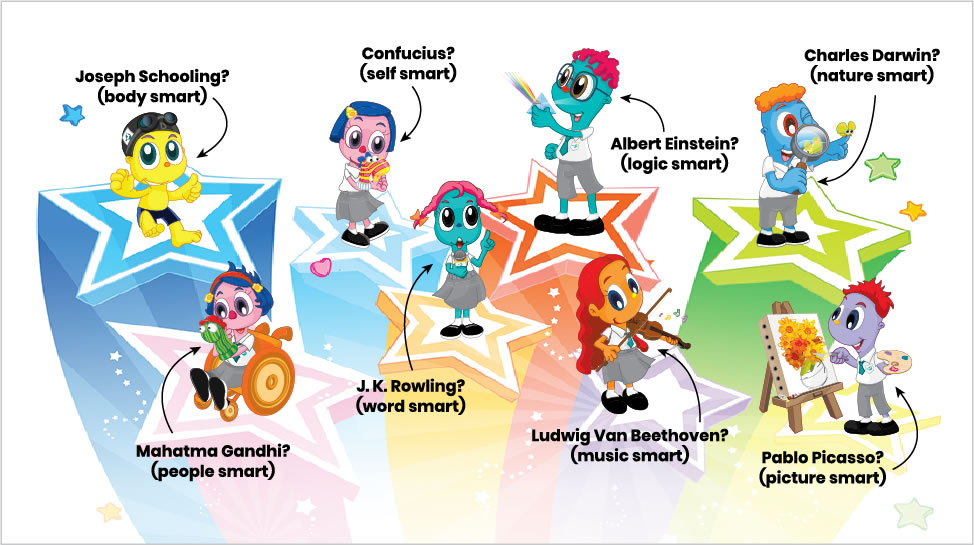
Nurturing children’s natural abilities during early sensitivity periods is crucial for their full development. It’s not always easy to identify a child’s talents, but exposing him or her to a variety of experiences can help. The Theory of Multiple Intelligences by Harvard University Professor Howard Gardner highlights the diversity in human intelligence, ranging from linguistic (word smart) to interpersonal (people smart) skills. Our curriculum incorporates activities across these intelligences to help children discover and grow their unique talents.
It’s beneficial for children to explore various interests, even if they move on from one to another. This exploration is key to finding a passion they’re willing to invest in. Given the future importance of soft skills and individual talents, early years are the best time for development, before the pressures of academic life increase. This approach allows children to develop a well-rounded set of skills and interests, laying a strong foundation for their future.
I chanced upon my first passion when I was 13 years old while browsing library books. I was fascinated by a book on Project Apollo to send men to the moon. The book was in English and at that time I was still in Hong Kong with very limited English language ability. Yet, that did not stop me from finding out everything about how a rocket works and how to send men to the moon. Because of this, I wanted to study aerospace engineering. Since my college did not offer this subject, I majored in physics instead. From my own experience, I strongly believe in exposing children to different things to hopefully help them find their passion. Believe me, when you find your passion, it really drives you.
I was hit by another passion in 2018. This time it was AI. This was way before ChatGPT’s debut in Nov 2022. I was so intrigued by AI that I attended a course on it in 2019. Then, in 2021, during COVID, I attended a Deep Learning Coursera online course, taught by the legendary Stanford AI guru, Professor Andrew Ng.
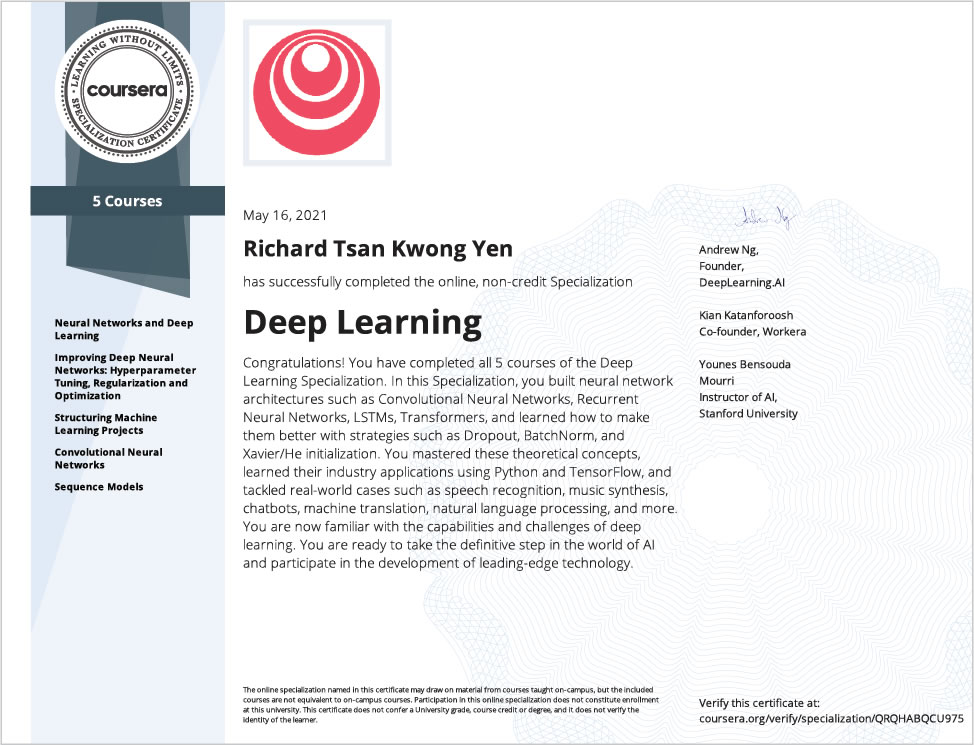
This passion resulted in our development of AI Chinese, AI Maths, and AI English, all of which are now being used at Cambridge. We also developed AI Oral Chinese with more to come.
My firsthand experience again shows the importance of finding your passion and developing your talent. This can really make a difference.
Reflections
- As AI continues to infiltrate the world, the value of people skills such as empathy, communication, and collaboration will increase. Reflect on whether you’re balancing your child’s development in both academic and interpersonal skills.
- In a culture of instant gratification, fostering self-control and the ability to delay gratification is crucial for your child’s success. Consider how often you try to immediately fulfill your child’s desires.
- Is your child ready to learn? Assessing your child’s readiness through an Executive Function (EF) evaluation can offer insights into his or her learning potential and suggest any necessary interventions.