The best pre-school activities for three-year-olds are often the ones that feel simple, enjoyable and easy to repeat. At this age, children are developing language, coordination, attention, imagination and independence all at once. A short activity at home can help a child listen more closely, express ideas more clearly, solve small problems and grow in confidence through everyday experiences.
For parents, that makes home one of the most important learning environments of all. Meaningful learning grows through experiences that match the way three-year-olds learn best: through movement, hands-on discovery, stories, pretend play, and repeated opportunities to try things for themselves.
Move and Play
Movement-based activities are some of the most effective ones to recreate at home because they help children organise both body and attention.
A simple obstacle course using cushions, tape lines and chairs can become a strong learning experience. Ask your child to hop to one point, crawl under a chair, balance along a line, then find something blue in the room. Shape hunts, colour hunts and follow-the-leader games also work well because they combine movement with listening and observation. Action songs are another excellent option, especially for children who respond well to rhythm and repetition.
These activities build coordination, and also help children manage impulses, follow sequences and stay with a task. At three, that matters because focus is still developing through action. When children move with purpose, they are learning how to listen with their whole body.
Make and Explore
Hands-on activities give three-year-olds a direct way to understand how things work.
Everyday objects are enough. Cups, spoons, containers, boxes, paper rolls and cloth pegs can all become useful learning materials. Your child can stack and compare cups, sort household items by color or size, build towers with recycled materials, scoop and pour water, or help mix ingredients during baking. These are practical, engaging activities that strengthen fine motor control and early reasoning.
The value lies in the thinking inside the activity. A child notices which tower falls first, which container holds more, or why one object fits while another does not. They are building early ideas about cause and effect, comparison, pattern and structure through direct experience. At this age, understanding becomes stronger when a child can test an idea with their hands and see the result for themselves.
With over 30 years of experience in the pre-school education space, our iSTEAM curriculum is built around “thinking with hands”, hands-on inquiry and open-ended exploration in fun, age-appropriate ways. We see exploration as one of the clearest ways young children learn deeply. When a child experiments with water, builds with boxes or investigates how materials behave, that child is already doing the early work of observing, questioning and making connections. That is why hands-on activities at home matter so much. They nurture the same habits of curiosity and investigation that support future-ready learning in school.
Read and Talk
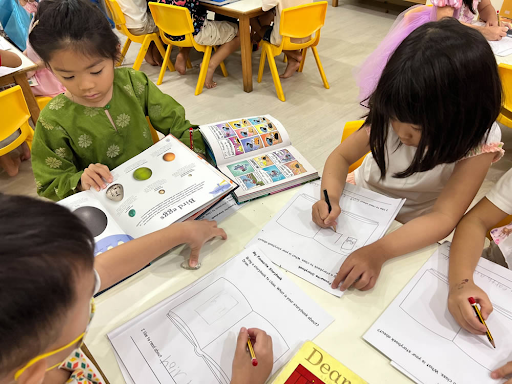
Language grows through interaction, and some of the best language activities for three-year-olds are the ones families can return to every day.
Read aloud regularly using books with rhythm, repetition and clear illustrations. Pause as you read and invite your child to respond. Ask what they notice, what they think might happen next, or how a character may be feeling. Let them point, guess, repeat and describe. These small exchanges build vocabulary and comprehension in a natural way.
Songs and rhymes are equally helpful because they strengthen memory, sound awareness and verbal confidence. Action songs are especially effective for children who engage more readily when language is paired with movement. Daily routines can also become rich language activities. Ask your child to describe a drawing, tell you what happened during play, or help name items while shopping or tidying up.
At Cambridge Pre-school, our English Language and Literacy curriculum helps children experience language as something meaningful and enjoyable. We believe strong communication begins not only with recognizing words, but with using language to imagine, connect and be understood. At home, parents can support this foundation by making reading interactive, engaging and part of everyday conversation.
Do It Themselves
Practical activities deserve just as much attention because independence is a major part of development at three.
Invite your child to put away toys, carry a plate, wipe a table, wash their hands, put on shoes or help pack a bag. These tasks are manageable, visible and satisfying. They help children experience themselves as capable, and that feeling is important. It shapes how they respond to new routines, transitions and challenges.
That is why Self-Help Skills are an important part of our curriculum at Cambridge Pre-school. Through practical, age-appropriate routines such as dressing independently, tidying up after play and caring for their surroundings, children build confidence in managing everyday tasks. We see independence as more than doing things alone. It is also about developing responsibility, self-awareness and confidence. When these habits are reinforced at home, children are more likely to carry them with consistency and assurance.
Final Thoughts
The best pre-school activities for three-year-olds are the ones children can return to often with interest and confidence. Movement, making, reading, pretend play and everyday responsibility all create strong learning opportunities when they are part of normal home life.
We believe these early years should be filled with purposeful experiences that help children become confident, curious and capable learners. Book a school tour and discover how our curriculum gives children a strong start in learning, growth, and confidence from day one.