
Chapter 2
My Story Continues
I had a great mum who took care of me and my two younger brothers. Because she was quite traditional, she wanted us to just focus on our studies and she took care of everything else. As a result, I did not learn many self-help skills; you can say that I had a pampered life.
I believe one consequence of this is that I become a very messy person. My table and drawers were always a mess because someone else was always picking up after me. I lacked the skills and practise to organise things.
You may think the impact was limited to my childhood years, but it had far-ranging consequences as illustrated by this story from when I was 21 years old.
When I was at Harvard, I lived in the dorm. One day, my aunt from Boston invited me for dinner. Afterward, she gave me some fruits and a frozen chicken to bring back. Since I didn’t know how to cook, I called my mum. She told me to wash it, season it with salt and pepper, and put it in the oven to roast it. I then cooked rice and looked forward to my dinner. However, the chicken turned out way too salty and dry. I couldn’t eat it and went out for dinner instead. I attributed this to my poor cooking skills and forgot about this incident. Two weeks later my mum was talking to my aunt over the phone and complained that she should not give me raw chicken as I don’t know how to cook. My aunt replied: “What raw chicken. It’s already cooked!” In my defence, I must say my aunt’s cooking was not that great and the frozen albino-looking whole chicken looked raw to me.
In Singapore today, many families only have one child, making them more precious. Furthermore, many families also have a maid. So knowingly or unknowingly, we tend to over-pamper our children. It is important for us to consciously provide opportunities for them to do household chores so that they not only pick up these important life skills but also not take things for granted. Some of you may remember the news article some years back that showed a national services man with a maid carrying his army backpack!
Practical Life Skills
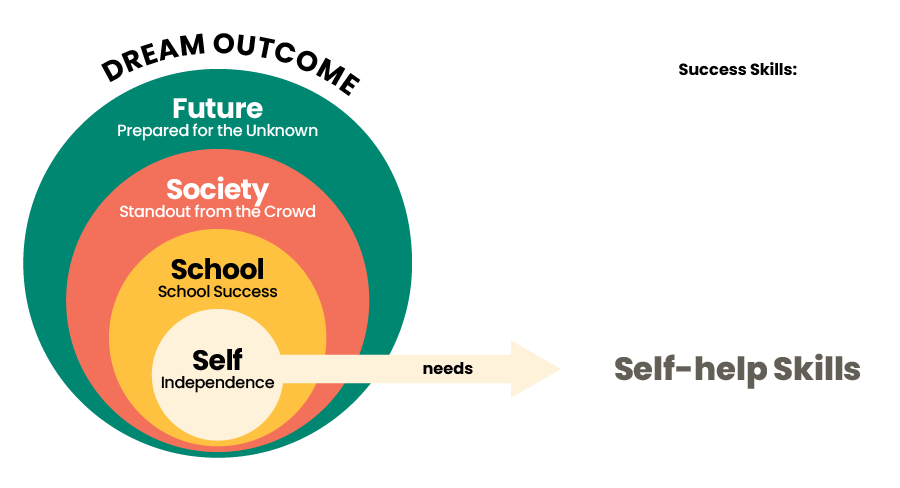
At Cambridge, we focus on teaching self-help skills through our practical life skills programme, which starts with toddlers. We want to empower children to become confident, capable, and independent individuals who are well-equipped to navigate the world around them. These skills lay the foundation for future success and promote a sense of autonomy, competence, self-reliance and self-esteem.
The core belief of our practical life skills programme is that one needs to independently perform daily life activities and adapt and orientate oneself in society. We recognise that developing independence is a gradual process that takes time and practice. Therefore, practical life skills are incorporated into our daily routine in school. The children are given age-appropriate responsibilities and classroom chores to help them develop a sense of ownership and accountability. We focus on three main areas:
- Good manners by developing social etiquette (e.g. turn taking and sharing), social manners (e.g. social greetings), and respect for others (e.g. listening attentively and seeking permission to use materials)
- Care of self by nurturing independence (e.g. taking care of belongings, completing tasks-at-hand), self-help skills (e.g. feeding, dressing and combing hair), and good habits to ensure good health (e.g. healthy eating and proper toothbrushing), hygiene (e.g. washing hands before and after eating), and safety (e.g. safe use of cissors and on the playground)
- Care of environment by cultivating a responsibility for the environment (e.g. putting away toys and throwing away rubbish)
Parents can support this development at home. Harvard research shows that if you want to raise more successful and happier kids, give them chores starting at age 4 or 5 years old.
Research from the ongoing 85-year Harvard study highlights a notable correlation between childhood involvement in household chores and future professional accomplishments. Examining more than 700 high achievers, researchers found that those who participated in household tasks tended to exhibit greater success in their careers later in life. This suggests that engaging in chores during childhood may instill valuable qualities that contribute to professional success, such as responsibility and a strong work ethic.
Moreover, involvement in shared responsibilities within the family structure fosters a sense of belonging and empathy in children. By understanding the needs of others and contributing to the household, children develop a broader perspective and become less self-centred. This not only benefits their personal development but also enhances their willingness to help others and collaborate effectively in professional settings later in life.
Reflections
- Reflect on how you balance nurturing with instilling responsibility and independence in your parenting practices. Are there areas where you could encourage more self-reliance?
- Think about how practical life skills are supported both at home and through your children’s schooling. How do the lessons from school align with the values and skills you emphasise at home?
- Consider practical ways to encourage your children to take on more responsibility in their daily routines, helping them develop the skills they need for the future.