
Most children arrive at nursery at three or four years old with a handful of familiar words and little else. Home has given them their first experiences with language. But in nursery, surrounded by peers and experienced early childhood educators, is where their language development begins to accelerate.
This stage carries more developmental weight than most parents expect. The habits formed during this period help shape the learners they become. How they listen, how they reach for words in an unfamiliar moment, how they start organising their thinking through language.
Where Social Confidence Gets Built
Nursery happens to be the first environment most three- and four-year-olds navigate without a parent close by and is also the most formative. Joining a group, taking a turn and telling a teacher what they need all require language that is still very much taking shape.
As young learners encounter unfamiliar ground across the school day, words become genuine tools. They learn that saying “I had that first” achieves more than grabbing, and asking a question gets an answer.
What makes these small exchanges consequential is not so much the vocabulary gained but rather the feedback they produce. That experience, repeated across dozens of interactions through the course of a nursery day, builds a working model of communication as something reliable.
By the end of the nursery year, those who have been consistently encouraged to speak, negotiate and describe what they are thinking carry those reflexes forward.
Speaking up begins to feel natural. Putting language to work in a difficult moment becomes a genuine option. Over time, this influences how readily a young learner engages with learning from primary school onward.
The Bridge Between Speaking and Reading
A strong English foundation also supports early reading development as a Primary School milestone. The formal mechanics, letter sounds, blending and decoding, do start there. The readiness for it is assembled much earlier, and this is where that process takes root.
At this age, young learners naturally absorb the rhythms and structures of spoken English at their most receptive. Time spent building conversation, asking questions and listening to stories builds an instinct for how sentences move and how meaning shifts with phrasing. When those same patterns appear on a page, the shape of them is already familiar. These early literacy experiences are only one part of how nursery supports language development. Every interaction throughout the day contributes to building a child’s confidence in English.
How Nursery Builds a Strong English Foundation
Parents often wonder how a nursery helps children become confident English communicators. The answer lies not in formal lessons or worksheets but in creating a language-rich environment where children use English naturally throughout the day.
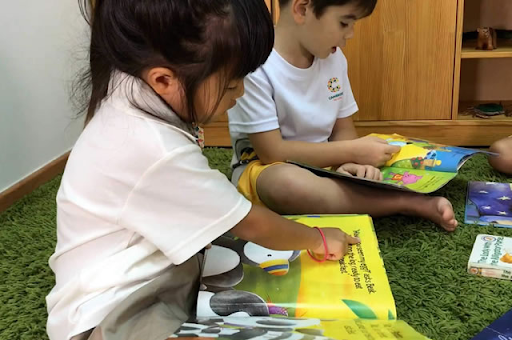
Every activity becomes an opportunity to build communication. During story time, children are introduced to new vocabulary, sentence patterns and ideas through carefully selected picture books and storytelling. Songs and rhymes strengthen listening skills while helping children remember new words through rhythm and repetition.
Teachers also encourage children to express themselves during everyday conversations. Whether they are describing a drawing, sharing what happened over the weekend or explaining how they solved a problem. Through these conversations, they learn to organise their thoughts and communicate with growing confidence.
Role play is another important part of language development. Pretending to run a shop, care for a patient or prepare a meal encourages children to use new vocabulary in meaningful situations while developing social and communication skills at the same time.
Open-ended questioning also plays a significant role. Rather than simply asking questions with right or wrong answers, educators encourage children to think more deeply with prompts such as “Why do you think that happened?”, “What might happen next?” or “How could we solve this problem?” These conversations help children build vocabulary while strengthening reasoning and critical thinking.
At Cambridge Pre-school, these experiences are woven naturally into every school day. Through programmes such as Literature Alive, hands-on iSTEAM activities and purposeful teacher-child interactions, children are given frequent opportunities to listen, speak, question and express themselves. Over time, these everyday experiences build the strong English foundation that supports confident communication, early literacy and lifelong learning.
Language as a Tool for Thinking
A strong English foundation gives young learners the vocabulary they need to think clearly. As their vocabulary grows, they begin reasoning about things beyond what is immediately in front of them. Why something happened, what might happen next, what would change if something were different. Language and thought develop together, and the nursery year is when that relationship first takes shape.
Putting an observation into words organises the thought itself. When a child says “it fell because it was wobbly”, they are reasoning in real time. The act of articulating it sharpens their understanding of what they just saw far more than the observation alone would. At this age, that kind of verbal processing is also how abstract ideas start to become manageable.
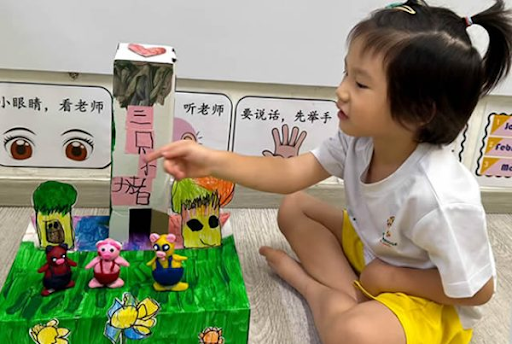
Our iSTEAM curriculum is built around this connection. Hands-on investigation gives students something genuinely worth explaining, and we expect them to share their findings with a teacher or the group. Forming and expressing a conclusion is the step that turns an activity into a lesson a child has worked out for themselves, and that is precisely what our sessions are designed to draw out.
Why This Year Carries So Much Weight
The nursery year is brief, and what it produces when language development is taken seriously during it has a much longer reach. A child who spends this period in a nursery environment that actively builds communication skills arrives at primary school ready to participate.
The confidence to speak up, the vocabulary to engage with unfamiliar ideas and the habit of listening carefully are qualities that compound over time. They determine how readily a child steps forward, how quickly they settle into new environments and how comfortably they take on the challenges that each stage of schooling brings. Every one of those qualities is built, steadily and deliberately, during this year.
A Foundation That Follows Them
Primary school rewards children who can listen, articulate and engage. Not because those are the only qualities that matter, but because they are the ones that determine how openly they receive new information, how effectively they communicate when they need support and how clearly they articulate a response.
At Cambridge Pre-school, we take this responsibility seriously from the very first term. Through meaningful conversations, rich literature and hands-on learning experiences, we intentionally nurture confident communicators who are ready to learn, express themselves and thrive. Book a school tour today to see our approach in action.