
Holistic development takes a whole-child approach to early education, supporting a child’s social, emotional, cognitive and physical development alongside academic learning.
But what does holistic development actually look like at a nursery level? Drawing on Singapore’s early childhood frameworks, we share six signs parents can look for when choosing a nursery programme that supports holistic development in practice, not just in name.
Defining Holistic in the Context of the Nursery Years
To understand what holistic means during the nursery years, it helps to look at how child development is mapped across the two distinct national frameworks: the ECDA’s Early Years Development Framework and the MOE’s Nurturing Early Learners Framework.
The nursery years span an important developmental transition. Nursery 1 generally falls within the age range addressed by ECDA’s Early Years Development Framework (EYDF), while Nursery 2 moves into the age range covered by MOE’s Nurturing Early Learners (NEL) Framework. Together, these frameworks provide useful guidance on how children’s development progresses across the early years.
ECDA’s Early Years Development Framework governs the first part, focusing on four core areas: cognitive, communication and language, physical, and social and emotional development.
From age four, the MOE’s Nurturing Early Learners (NEL) Framework takes over, expanding into five specific learning areas: Aesthetics and Creative Expression, Discovery of the World, Health, Safety and Motor Skills, Language and Literacy, and Numeracy. These are underpinned by three essential pillars: values, social and emotional competencies, and learning dispositions.
What Holistic Development Looks Like in a Nursery
The areas below split naturally into six categories you can evaluate on a tour, some visible the moment you walk into a room and some you can only catch happening in real time.
1. Social-Emotional Learning (SEL) & Values
You cannot exactly measure social-emotional learning through a banner or a poster, but it often manifest in the way teachers co-regulate a child’s big feelings, or in how children treat each other when nobody is telling them to.
For example, when a child becomes upset, does the teacher get down to the child’s eye level, acknowledge what they are feeling and give them time and support to settle? These everyday interactions can help children gradually develop emotional awareness and self-regulation.
This thinking is reflected in our People Skills as part of our curriculum, where Executive Function skills such as self-regulation, working memory and cognitive flexibility are developed through age-appropriate activities and guided practice.
The same applies to what children do on their own, whether it is negotiating over a toy, or bringing a tissue to a classmate who is upset without being asked. Both are signs that empathy and self-management are becoming theirs rather than being something an adult has to keep supplying.
2. Aesthetics & Creative Expression
Unlike social-emotional learning, aesthetics and creative expression are a lot more observable. Look for a balance between the creative process and the finished product. Children’s artwork does not always need to look identical. Variation can be a positive sign that children have been given opportunities to make choices, experiment and express their own ideas.
We recommend also asking whether drawing, clay, or instruments are things children can reach for through the day, or only appear for a scheduled half hour on Fridays.
The structure of the curriculum offers clear insight into whether the emphasis lies on child-led exploration (the process) or teacher-directed instruction (the outcome). A combination of both types is ideal for a nursery programme.
3. Discovery of the World & Cognitive Development
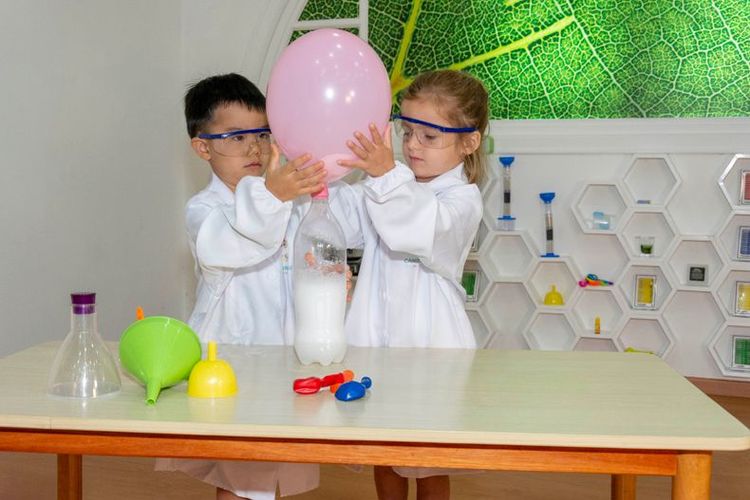
Cognitive development at this age is strengthened through curiosity, exploration and opportunities to test ideas. For example, when a child asks why the sky is blue, turning the question back with “what do you think, and how could we find out?” teaches investigation in a way a flat correct answer never will.
To evaluate this, listen for inquiry-based language. Pay attention to how teachers interact with the children. Do they immediately provide correct answers to questions or do they respond with prompts like, “That’s an interesting thought, what do you think is happening?”
You can also look for materials that allow for hands-on experimentation such as magnifying glasses, measuring tools, natural items, or water/sand play, as opposed to just worksheets or fact-based posters.
At Cambridge Pre-school, our iSTEAM curriculum encourages this kind of hands-on discovery. Nursery children explore materials, test ideas and gradually progress towards more inquiry-based learning as they grow.
4. Language, Literacy & Communication
In Singapore’s bilingual environment, language development involves more than learning phonics or recognising words. Children also need regular opportunities to listen, speak and use language confidently in meaningful situations.
A language-rich classroom gives children opportunities to ask questions, tell stories, negotiate with friends and express their ideas rather than spending most of their time listening passively.
Parents can also observe how English and Mother Tongue are incorporated into the school day and whether children have meaningful opportunities to use both languages beyond formal instruction.
5. Health, Safety & Motor Skills
Physical development at this age is a blend of gross and fine motor progression and the development of self-care independence. When evaluating a centre, you can look for two primary indicators: supported risk-taking and functional independence.
Look for age-appropriate opportunities for children to climb, balance, run and develop physical confidence within a safe and supervised environment. Teachers can provide support when needed while still giving children space to try things for themselves.
The daily routine should also leave time for functional independence, allowing children to practise self-care tasks like putting on their own shoes, washing hands, or pouring water.
Our Self-Help for Independence programme runs on the same principle, building in unhurried time for children to manage their own routines rather than treating self-care as something to squeeze in around the rest of the timetable.
In these moments, teachers act as facilitators, patiently allowing children the space to try, fail, and eventually succeed on their own rather than rushing to do it for them.
6. Learning Dispositions
Learning dispositions such as perseverance, curiosity and resilience influence how children approach new experiences and respond when things do not go as planned. One way parents can observe this during a school visit is by noticing how educators respond to children’s mistakes and setbacks.
For example, educators might acknowledge a child’s effort with, “I noticed how you kept trying to balance those blocks,” rather than focusing only on whether the final result was successful.
In a great nursery environment, educators also treat setbacks as teachable moments for building resilience. When milk spills or a project collapses, the response is neutral and collaborative, such as “No problem, let’s find a way to fix it together”.
Through this approach, children develop a healthy, confident attitude toward learning. They move forward understanding that errors are simply manageable steps in their journey of exploration, rather than sources of shame or reasons to quit.
Final Thoughts
None of these six areas tends to show up as one dramatic moment during a tour. Instead, they surface in small, ordinary interactions that are easy to miss.
Walking in with a few of these specific behaviours in mind and asking questions will give you a much clearer picture of a nursery programme than general impressions of the room can offer on their own.
Want to see what holistic development looks like in practice? Book a school tour at your nearest Cambridge Pre-school centre and experience how our curriculum supports children’s learning and development every day.