It is difficult to predict exactly what the future workplace will look like for today’s four-year-olds. The tools they will use may not exist yet, and neither might some of the industries they’ll eventually work in.
A strong STEM pre-school curriculum does not prepare children for one specific future. Instead, it equips them with thinking skills that remain valuable no matter how the world changes.
At Cambridge Pre-school, those habits come to life in experiences such as a four-year-old testing which objects in a water tray float or sink, or arranging wooden ramps at different angles and changing something every time the ball rolls down.
Each of those moments is playing an essential role in fostering traits and habits that shape who they become, whether it is cultivating design thinking or strengthening neural pathways that accelerate cognitive processing. In this article, we will explore how these activities, at this developmental stage, help prepare them for the future.
1. Building Real Critical Thinkers
When a nursery child, for example, investigates why some objects block light and others let it through, they step through a specific sequence of observation, prediction, experimentation and revision.
Repeated across subjects and materials, that pattern builds the foundation of structured reasoning, which is essentially a problem-solving approach that involves breaking complex issues into logical, traceable steps. Each time the habit is practised, it grows more automatic and more transferable.
At Cambridge Pre-school, our iSTEAM curriculum carries this approach from nursery through kindergarten. By the time students reach kindergarten level, they are using magnifiers to compare their own fingerprints and giving step-by-step instructions to guide a classmate through a maze. These are problems they reason through, document and explain to a peer. Over time, that process stops being a framework to follow and becomes the way they naturally think.
2. Developing a Scientific Mind
Critical thinking is a skill. Scientific curiosity is what keeps a child returning to it willingly. In a strong STEM programme, both develop together, each one deepening the other.
Say, for example, a toddler drops objects into a water tray, calls their prediction out loud and then observes what actually happens. When a result lands differently from what they anticipated, and they are reconsidering what they expected and deciding what to try next, they are already thinking like a scientist.
The drive to find out why, other than being a moment of genuine learning, is the foundation upon which lifelong curiosity and scientific thinking is built. And that is precisely why Cambridge Pre-school sustains that drive deliberately.
One moment learners are growing plants from seeds and tracking what shifts week by week. Next they are testing which surfaces conduct electricity and which stay inert. The goal, besides allowing them to arrive at answers themselves, is to build a permanent analytical mindset.
3. Resilience as a Future Skill
Persisting through repeated attempts is one of the most consequential qualities to establish before formal schooling begins. It determines how children respond when a subject gets hard, whether they keep going when a task pushes back.
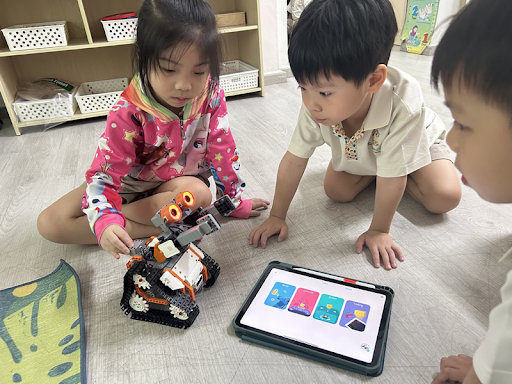
This is exactly what a strong STEM curriculum is designed to build in. The Cambridge Pre-school iSTEAM curriculum is structured such that getting to the right outcome takes more than one try. This process encourages children to observe, adjust and try again.
For example, when a bridge that a child built gives way mid-build, that moment can look like a setback. However, our students are taught not to give up, but find a solution to the problem. Over time, the child stops looking for the right answer on the first try and starts expecting the process to take more than one attempt. That shift in expectation is where resilience actually forms.
4. Technology Fluency as a Foundation
Technology today is woven into how children learn, play and make sense of the world around them. But there is a meaningful difference between growing up as a consumer of technology and growing up as someone who directs it. Early coding and robotics address that distinction at exactly the right moment, helping children understand how technology works rather than simply using it.
This is exactly what our iSTEAM Inquiry curriculum is designed to deliver. Sequences of movement get programmed, animations worked through and robotics built in ways that require genuine logical reasoning. In time, children grow to view technology not as entertainment or passive distraction, but as a malleable tool they can control, adapt and use to solve real problems.
The skills and logical habits built through programming, building and troubleshooting, that technology fluency transfers across subjects and situations, and determines how young learners engage with a world where technology permeates every aspect of the human experience.
5. Where Workforce Readiness Begins
By the time a STEM-educated child reaches the workforce, critical thinking, scientific literacy, resilience and technology fluency are already second nature. How the brain organises information, processes competing ideas and places attention where it is needed most is what shapes how well they perform. These mental skills are known as Executive Function and it begins forming in the pre-school years.
Executive Function governs working memory, cognitive flexibility, planning, organisation and problem-solving, the mental skills that determine how clearly a person thinks under pressure and how well they manage complexity as it increases.
These are the same capacities employers consistently identify as markers of high performance. The earlier they develop, the more deeply they embed, influencing how children learn in school, as well as how they eventually show up in the workplace.
Final Thoughts
A STEM pre-school curriculum reaches children at the exact moment their brain is most receptive, when curiosity is natural, when habits form quickly and when the foundations of thinking are still being laid.
The future will keep changing and keep asking more of the people navigating it. A child who leaves the pre-school years as a confident thinker, a curious investigator and a resilient problem-solver is equipped with the cognitive infrastructure and resilience to thrive in and out of the classroom.
At Cambridge Pre-school, our programmes are designed with that understanding at the centre. Book a school tour today to learn more about how we are building tomorrow’s leaders, thinkers and innovators.